
The Short Version
Strong gift card sales don’t necessarily mean a healthy program. A healthy gift card program delivers measurable, incremental value to the business, keeps pace with changes in fraud, technology, and customer expectations, and makes full use of the stored value infrastructure the brand has already built.
Jenny DeTerra, VP of Merchant Solutions at eGifter, explains how gift card program managers can evaluate program health and find new ways to put their gift card infrastructure to work.
Jump Ahead!
Click a section to jump to what you need.
Why gift card program health goes beyond sales
Gift card sales are up. Great. But does that mean the program is healthy?
Not necessarily.
Sales are one important measure of performance, but a healthy gift card program is about much more than how much value you load onto cards. To really understand the health of your program, look at three things:
- Is it delivering measurable value? Are gift cards driving incremental sales, bringing in new customers, increasing spend, or encouraging customers to come back more often?
- Is it keeping pace? Is your technology evolving to support current expectations around security, fraud prevention, data visibility, and customer experience?
- Are you using it to its full potential? You’ve already built the gift card infrastructure. Could you be using it for more than gifting, such as merchandise returns, promotional value, loyalty, incentives, or other stored value applications across the business?
I sat down with Jenny DeTerra, VP of Merchant Solutions at eGifter, to talk about what a healthy gift card program really looks like and why brands need to think beyond sales when evaluating where their programs are today and where they need to go next.
Where should new gift card program managers start?
Jenny: The first thing I’d do is figure out who owns the gift card program and sit down with them. In our industry, it’s not uncommon for a gift card program to sit in Marketing, Finance, Payments, or another area of the business. So I want to know who is ultimately accountable for the program’s performance, what they expect it to accomplish, and how they define success.
That matters because the answer can look very different depending on who owns the program.
I’ve experienced that firsthand. I worked with a gift card program that sat under Marketing, where we were focused on driving sales and customer traffic. When the program moved under Finance, the same program was viewed through a very different lens. Things like cost, breakage, float, and risk became much more important.
It was a little painful at first, but it forced us to look much more closely at the economics of the program. It wasn’t enough to say we sold a certain amount in gift cards. We had to understand what those sales were costing us, whether they were actually incremental, and ultimately how much value the program was driving for the business.
That changed the way I thought about program health. And I learned to appreciate the growth mindset of Marketing,and the financial discipline to understand whether that growth is actually creating value.

How do you know if a gift card program is creating value?
Jenny: First, you absolutely need the sales data Nicole talked about. You need visibility into where your gift cards are being sold, how each channel is performing, and what those sales are costing you. If you’re selling through a third party or B2B channel, for example, what discount are you giving up? What other fees or investments are associated with that business? You need to understand the economics of the sale before you can really evaluate the return.
Once you have that picture, you want to determine what happens after the gift card is sold. For that, I turn to redemption data to ask questions like:
- How quickly do our gift cards get used? Are there differences by channel? You may have an incentive channel where cards are distributed but sit unused for a long time. Another channel may have a lot of self-use, where someone buys the gift card and redeems it almost immediately. Those are two very different behaviors, even though both show up as gift card sales.
- What happens when a gift card is redeemed? Look at the value of the gift card compared with the total transaction. How much are customers spending beyond the value of the card? And how does the average gift card redemption basket compare with your typical transaction?
- Who is redeeming the gift card, and how does it affect their behavior? If you can connect the redemption to a customer, ask if the gift card brings someone new to the brand? If it’s an existing customer, are they spending more than they normally would or visiting more frequently?
That last question is especially important because not every gift card sale is incremental.
Say one of your gift cards is available through a retailer that gives customers loyalty rewards for buying gift cards. A customer who already shops with your brand may buy your gift card there to earn those rewards and then use the card for a purchase they were going to make anyway.
From a sales perspective, that channel can look great. You sold a gift card. It was redeemed. The customer may even have spent beyond the value of the card. But if that customer was already going to spend that money with you, how much new value did the gift card actually create? And remember, you gave up some margin to the distribution partner to make that sale.
Now compare that with a channel that puts your gift card into the hands of someone who has never shopped with you before, or causes an existing customer to visit more often or spend more than they normally would. That sale may be creating much more incremental value.
That’s why I pay particular attention to incrementality. You don’t just want to know whether the gift card generated a transaction. You want to know what happened because of the gift card that wouldn’t have happened otherwise.

How should you use gift card program data?
Jenny: First, you can make much better decisions about the business.
If you understand incrementality and profitability by channel, you can see where you’re getting the greatest return and where you may be giving up margin without creating much new value. That can help you decide where to invest more, where to pull back, and which opportunities are worth pursuing.
But there isn’t necessarily one right answer. A brand may look at a channel with strong sales but relatively low incrementality and decide it doesn’t make sense to give up that margin for customers who were likely to shop with them anyway. Another brand might look at the exact same channel and say, I want as many of my gift cards out in the world as possible. They may value the brand exposure, the future redemption, and the opportunity to keep customers engaged.
The data doesn’t make the decision for you. It gives you the information to make the decision based on what matters most to your business.
The other thing it does is help you prove the value of the gift card program internally. Gift card managers are competing for resources and investment just like every other part of the organization. A big top-line sales number is great, but if you can show that the program is bringing in new customers, changing customer behavior, and driving incremental profit, you have a much stronger story to take to leadership.
And that matters when you want to do more with the program. Maybe you need development resources, better fraud tools, new technology, or funding for another initiative. When you can demonstrate what the gift card program is contributing to the business, it becomes much easier to build the case for investing in what it could do next.
Why keep investing in your gift card program?
Jenny: Because one of the biggest mistakes you can make is to set it and forget it.
A gift card program might be growing one or two percent every year and hitting its targets, so the natural reaction is, If it isn’t broken, why mess with it? But the industry keeps moving. Fraud changes. Technology changes. Customer expectations change. If your program doesn’t change with them, you can look up one day and realize you’re five years behind.
Fraud and security are a big part of that. A program can look perfectly healthy from a sales perspective while fraud is creating losses, frustrating customers, and damaging the brand. You have to continually evaluate whether your fraud rules, controls, and technology are keeping up with the threats you’re seeing.
Then look at the customer experience. Are you making gift cards as easy to use as customers now expect them to be? Can they add the card to a digital wallet? Do they have easy access to their balance? Are you taking advantage of newer capabilities that remove friction from purchasing, gifting, and redemption?
Data is part of the technology investment too. The questions we’ve been talking about are difficult to answer if your systems don’t give you enough visibility into what’s happening across the program. Sometimes relatively simple decisions, like using different card-number ranges for different channels or programs, can give you another way to identify where a card came from and follow what happens when it’s redeemed. The more granular your data is, the more questions you can answer.
That doesn’t mean you have to adopt every new feature or chase every trend. It means you should be continually asking whether your technology is keeping pace with the needs of your customers, your business, and the industry.
Because standing still has a cost too. The longer you wait to make those investments, the harder and more expensive it can become to catch up.
Are you getting everything out of your gift card program?
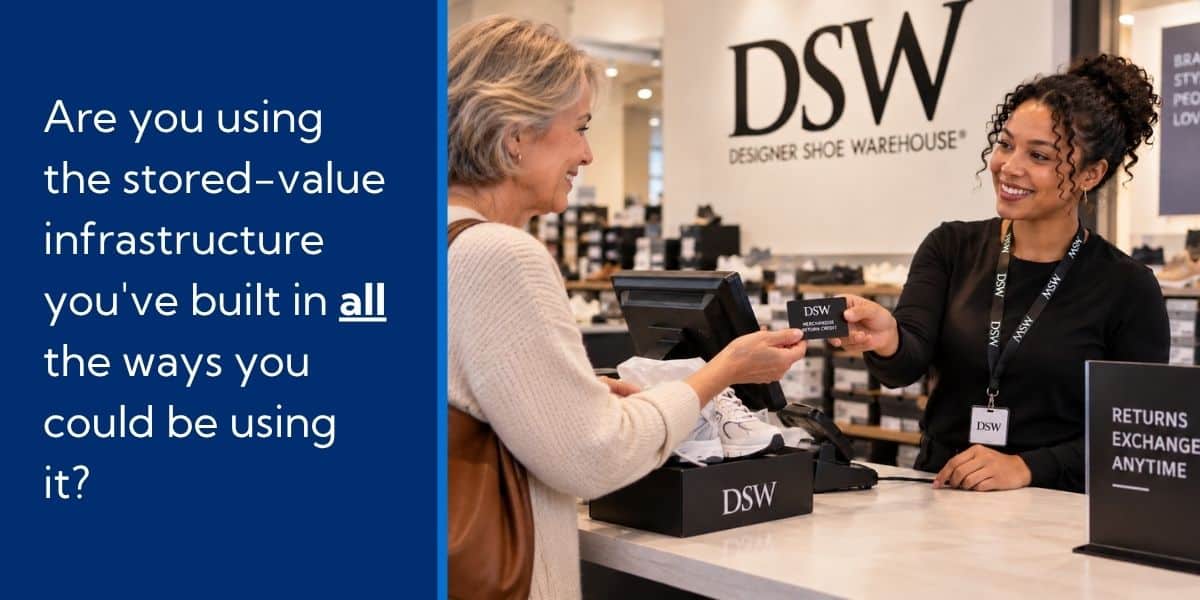
Jenny: I’d start by asking a really simple question: Are we using the infrastructure we’ve built in all the ways we could be using it?
We tend to think about gift cards in the most obvious way. Someone buys a card and gives it to someone else. But you’ve built an entire stored value infrastructure around that product, and it can potentially do much more for the business.
Merchandise returns are a great example. Instead of returning money to another form of payment, you can issue that value onto a card and keep those dollars within your brand. You can also use the same infrastructure to support loyalty programs, promotions, customer appeasement, incentives, and other stored value use cases.
So I’d look across the organization and ask where else that infrastructure could solve a problem or create an opportunity. If you’re only thinking about your gift card as something hanging on a peg or sold on your website, you may be missing a much bigger opportunity.
To me, that’s another sign of a healthy program. You understand the value it’s creating today, you’re continuing to invest so it stays current, and you’re looking for new ways to use what you’ve already built.
What’s the biggest takeaway for gift card program managers?
Jenny: Don’t assume that because your gift card sales are growing, your program is as healthy as it could be.
Take the time to understand what the program is actually contributing to the business. Keep investing in it as technology, fraud, and customer expectations change. And keep looking for ways the infrastructure you’ve built can do more for the organization.
Gift card programs touch so many parts of the business, and there’s often more opportunity there than people realize. The goal shouldn’t just be to keep the program running. It should be to understand what it’s capable of and keep finding ways to make it better.
Could your gift card program be doing more?
If you want to explore ways to put your gift card infrastructure to work beyond traditional gifting, talk with Jenny and the eGifter Professional Services team. We can help identify opportunities to use stored value in new ways across your business.
Thanks Jenny! Here’s my take.
As consumers, we don’t spend much time thinking about the technology behind gift cards. And frankly, we shouldn’t have to. What matters to me is consistency. Whether I purchase a gift card, receive merchandise return credit, or get a gift card as a customer service gesture, I want the same easy experience. I want to use it online or in-store, add it to my mobile wallet, and not have to think about what kind of stored value I’m holding. I look to retailers and their gift card technology partners to make that happen.
Jenny also made an interesting point about incrementality that got me thinking about my own shopping habits. I’m a budget-conscious shopper, and I absolutely look for discounted gift cards at places where I already plan to shop. When I’ve saved money before walking into the store, I’m often more inclined to spend a little more freely.
But sometimes the discount actually determines where I shop. If I need lightbulbs, for example, I could buy them at Lowe’s, The Home Depot, CVS, or Ace Hardware. I’m not particularly loyal to one over the others for that purchase. But if I can get a discounted gift card for one of them, that might be all it takes to influence my decision.
That’s what I find so interesting about gift cards. They can influence where we shop, how much we spend, and how we feel about the purchase—even when we’re buying something we already needed.
Lots to think about!
In the meantime, happy shopping and happy gifting!
— Shelley Hunter, Gift Card Expert at eGifter